
Definition
What is an autonomous business operating system?
An autonomous business OS is software that decides the next step, acts inside the owner's limits and measures the dollar result.
Esplanda POS and your website are free to start, with no card needed. Add paid tools only when you want them. See Esplanda pricing.
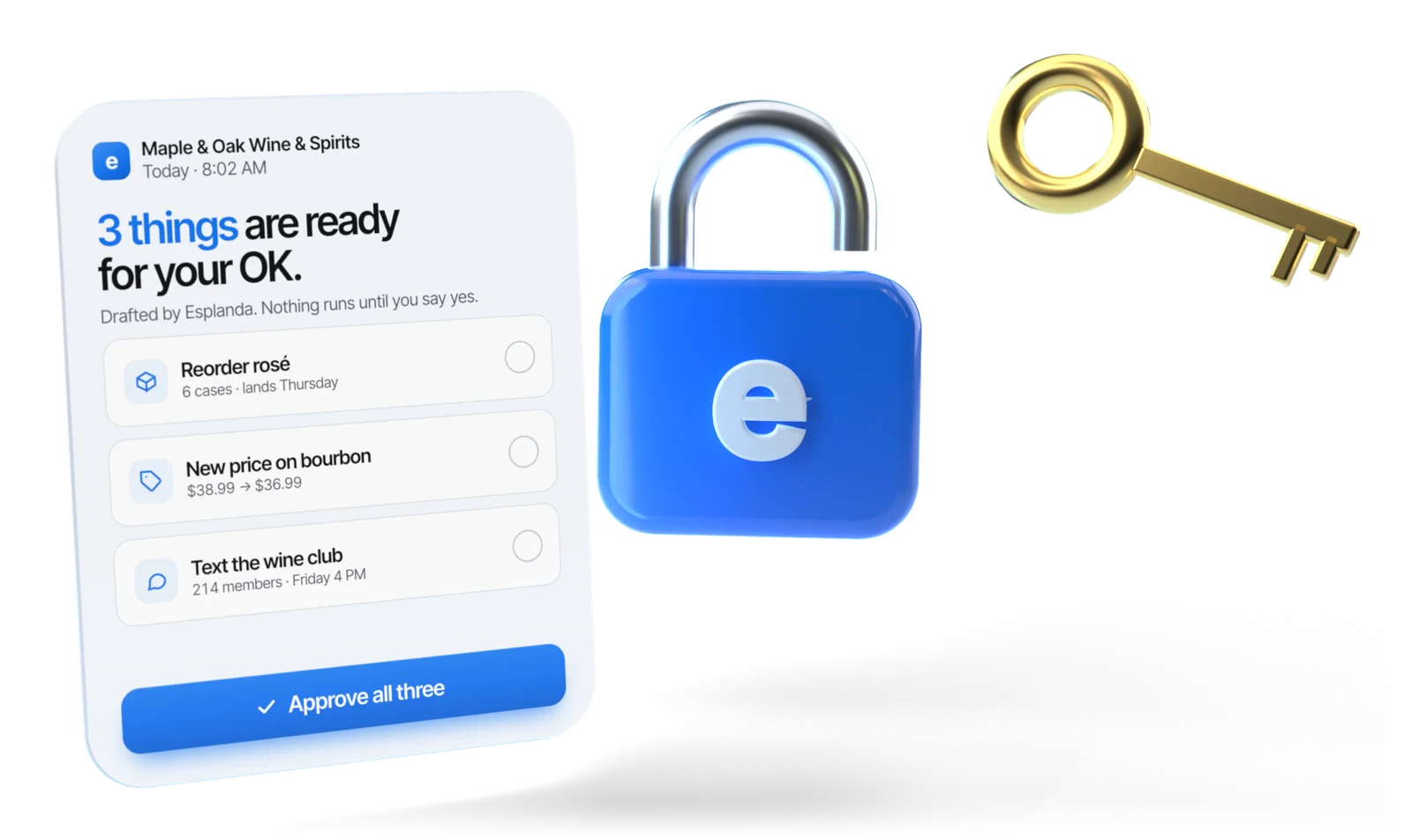
Illustrative example
In short
An autonomous business OS covers the recurring management work across the whole business (buying, pricing, marketing, customer communication and reporting) rather than one department. The owner sets goals and boundaries once; the software works inside them.
Automated software repeats a rule a human wrote. Autonomous software decides what the rule should be. The phrase itself is usually a warning sign, and the last section explains why.
- It decides
- It acts inside your limits
- It records what it predicted
- It measures the dollar result
Often confused with
Four things that get the name, and fall short
Each of these gets called an autonomous business operating system. Each one leaves the deciding, or the doing, with the owner.
A dashboard
A dashboard reports the past: what sales did, what stock is low, what margin was last month. Every decision still lands on the owner.
A report or alert tool
Reports and alerts move information towards you faster. They add decisions to your day rather than taking any away.
A point of sale on its own
A register records transactions and takes money: a system of record, which is a different thing from a system of action. A register can be part of one. Esplanda's own point of sale is, and so is a connected Square, Clover, Lightspeed or KORONA register.
A chat box bolted onto old software
A chat box changes how you ask the question, not who does the work. If every conversation ends in a list of things for you to do, only the interface changed.
The test
Four properties make software autonomous, not automated
Automated software repeats a rule a human wrote. Autonomous software decides what the rule should be, acts on it, and is accountable for the result. All four properties have to be present.
It decides
It works out what should happen next from current data, rather than waiting for a trigger you configured. If you set the threshold, the timing and the action yourself, that is automation, and it keeps executing your original judgment long after conditions have changed.
It acts inside limits you set
Deciding without acting is advice. Acting without limits is reckless. The workable version is bounded action: a maximum order value, a floor margin, a discount ceiling, a spend cap, approved suppliers. Anything outside the boundary becomes an approval request, and any capability can go back to advise-only.
It records what it predicted
Before acting, it writes down what it expects the action to produce, in dollars. This is the property most often missing, because it makes the software checkable: a prediction recorded in advance stays as it was written.
It measures the dollar result
Afterwards it measures what happened against the prediction, the misses along with the wins. Software that reports only its wins is not measuring, it is marketing. See how Esplanda measures results in the outcome ledger.
Levels of autonomy
Five levels of autonomy in business software
Most business software sits at level 1 or 2 and is sold as though it were at level 4. Use the scale to judge what a system does, and how much work it leaves with you.
| Level | What the software does | What the owner does | Typical example |
|---|---|---|---|
| 0 · Manual | Records what happened | Notices, decides, acts, checks | A register and a spreadsheet |
| 1 · Alerts | Notices and tells you | Decides, acts, checks | Low-stock alerts |
| 2 · Recommendations | Suggests an action | Judges it, acts, checks | Suggested reorder lists |
| 3 · Acts inside limits | Decides and does it inside stated boundaries | Sets limits, approves exceptions | Orders sent under a value cap |
| 4 · Acts and reports the result | Decides, acts, predicts the dollar result and measures it | Sets goals and limits, reads the ledger, overrules | An autonomous business operating system |
The step that matters is 3 to 4. Plenty of software can be configured to act; very little checks what it earned.
In Esplanda you set the level per kind of work: advise, prepare the work for your one-click OK, or act inside your limits. See the AI business copilot and how Esplanda works, step by step.
Built for
Who an autonomous business system is built for
Owner-operated businesses where one person carries the management load. Esplanda's task study of a typical single-location liquor store found roughly 117 management hours a month, across 156 recurring tasks.
Built for
- Liquor and wine stores, with a real catalog and repeat customers; see liquor store software.
- Grocery and convenience stores, where thousands of items reorder every week.
- Restaurants and bars, from food cost to the regulars who went quiet; see restaurant management software.
- Retail shops and service businesses with a catalog, a calendar and customers who come back.
- Multi-location operators, with every store on one set of numbers; see multi location inventory management.
What it works from
- Your own sales history: forecasts are useful after your first two to four weeks and get good over a year.
- A tidy catalog: products and costs kept clean, so every decision starts from the right numbers.
- Your limits: owners ready to let software act inside boundaries they set once.
- One system across the jobs: buying, pricing, marketing and customers together, rather than one tool per job.
Evaluating a vendor
How to test a vendor claiming the category
One question separates a real system from a marketing claim: what did you predict, what did you measure, and where did you miss? A vendor with an outcome record answers with numbers, misses and all. A vendor without one changes the subject to features, to a demo, or to how advanced the technology is.
Ask what it predicted and what it measured
Then ask about a miss specifically. Every real system has them, and a real one shows you where.
Ask what it does without being asked
Name a routine decision, such as next week's order. If it appears on a screen for you to act on, that is level 2.
Ask what limits you can set, and how you take them back
And whether any capability goes back to advise-only immediately, the moment you ask.
Ask which actions always come back to you
The list of things that always wait for a yes tells you more about a system than its feature list does.
Ask whether it makes you replace your register
The good answer allows both: keep the register you have, or use ours. Esplanda POS is free, and Esplanda also connects to Square, Clover, Lightspeed and KORONA. See POS integration.
Ask what happens when you leave
Customers, purchase history and the outcome record should export in standard formats. With Esplanda, you can export all of your data.
Apply all six to Esplanda, then see Esplanda pricing.
About the term
Why the phrase is usually a warning sign
The term is easy to claim and hard to check, which is exactly the profile of a phrase that gets abused.
It has been attached to reporting tools, workflow builders and chat interfaces, none of which decide or measure anything. That is why it appears on this page and almost nowhere else on this site: everywhere else, Esplanda describes what it does in plain words.
Start with what is checkable. The free business grader grades how your business looks from the outside, without you connecting anything, and AI retail analytics answers questions about your own numbers with the records behind every figure.
Questions
Autonomous business questions owners ask
What is an autonomous business operating system?
An autonomous business operating system is software that decides what should happen next in a business, acts inside limits the owner sets, and measures the dollar result. It covers the recurring management work across the whole business rather than one department. The owner sets goals and boundaries; the software does the work and reports what each action produced.
What is the difference between automated and autonomous?
Automated software repeats a rule a human wrote. Autonomous software decides what the rule should be. If you configured the trigger, the threshold and the action yourself, that is automation, and it will keep doing the wrong thing perfectly after conditions change.
Is an autonomous business operating system just a dashboard with AI on it?
No, and the difference is where the work stops. A dashboard reports the past and hands every decision back to the owner. Adding a chat box changes how you ask a question, not who does the work. If the software still leaves you with a list of things to go and do, it is a reporting tool.
Is it safe to let software act on its own in my business?
It is safe when it is bounded and reversible. The safety comes from limits set in advance (a maximum order value, a floor margin, a discount ceiling, a spend cap, an approved supplier list) and from anything outside those limits arriving as an approval instead of an action. In Esplanda, any capability can go back to advise-only at any time.
How do I evaluate a vendor claiming to be autonomous?
Ask one question: what did you predict, what did you measure, and where did you miss? A vendor with a real outcome record answers with numbers, misses and all. A vendor without one changes the subject to features, to a demo, or to how advanced the technology is.
Does an autonomous business operating system replace my point of sale?
It should not have to. Esplanda has its own point of sale and it is free, which is the cleaner path because sales and stock live in one system with no product matching and no nightly reconciliation. Esplanda also connects to Square, Clover, Lightspeed and KORONA registers. Keep the register you have, or use ours.
Who is an autonomous business system built for?
Owner-operated businesses where one person carries the management load, with a real catalog and repeat customers: liquor and wine stores, grocery and convenience stores, restaurants and bars, retail shops, service businesses and multi-location operators. Forecasts learn from your own sales, so they are useful after the first two to four weeks and get good over a year.
How much does an autonomous business operating system cost?
Esplanda POS is free, and the forecasts, the owner brief and the approval queue come with it. Paid tools, such as marketing or the AI phone, are separate lines, each bought on its own. There is no setup fee, no contract and no per-user fee. Every line is on Esplanda pricing.
Test the claim on your own business
Start free today, or book a demo and we'll show you what Esplanda predicted, what it measured, and which level each kind of work runs at.
Esplanda POS and your website are free to start, with no card needed. Add paid tools only when you want them.