
Business continuity
Offline POS system that keeps ringing sales
When the internet drops, Esplanda POS keeps ringing sales and syncs the day when the line is back, at no extra cost.
Esplanda POS is free, with no card needed to start. Export all of your data at any time.
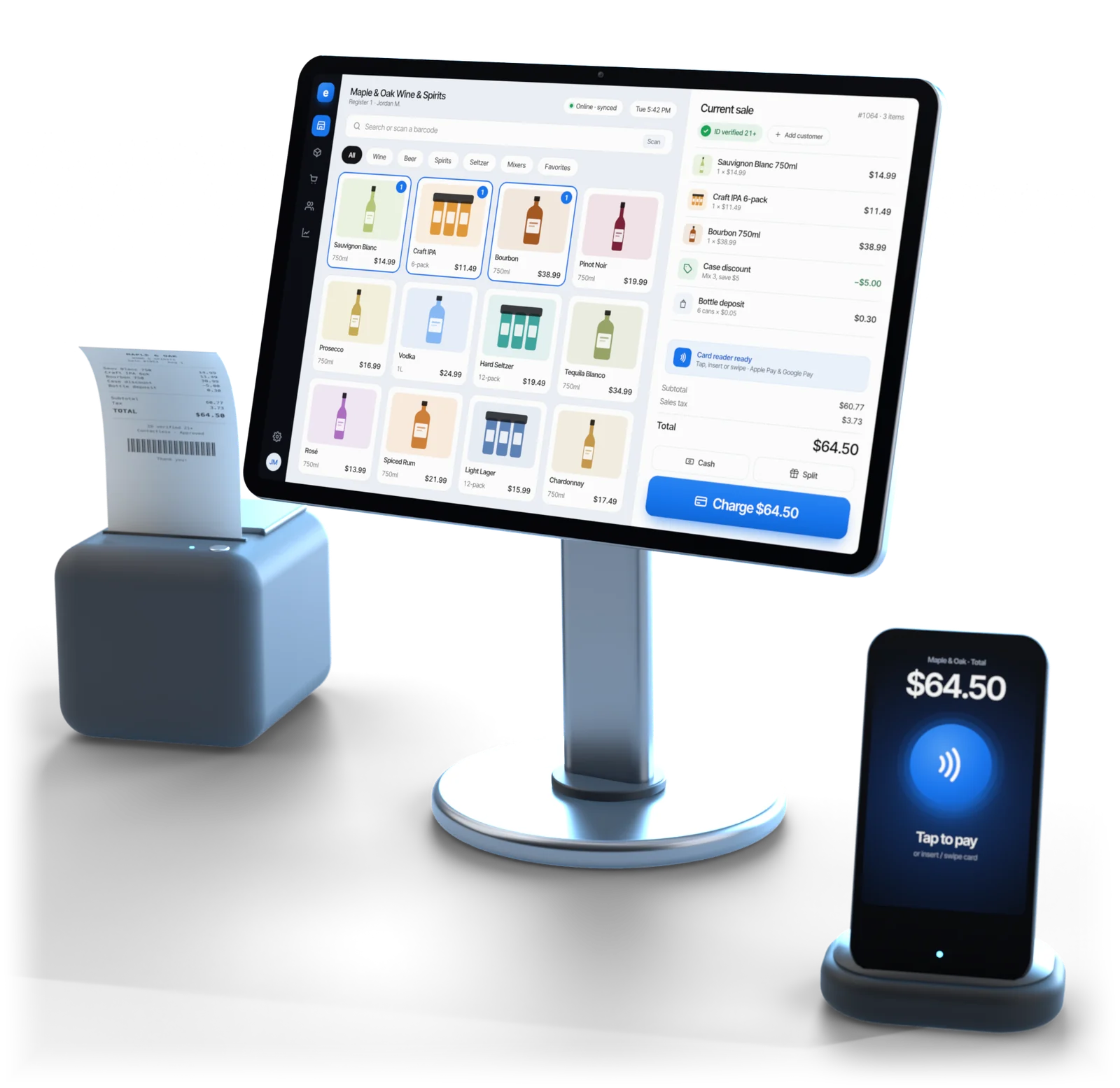
Illustrative example
In short
An offline POS system keeps ringing sales when the internet drops. Esplanda POS does that, and it plans for the other three failures too: a power cut, a card processor outage and Esplanda itself going down.
A complete data export is available at any time: products, customers, sales, purchase orders, suppliers. A merchant who leaves takes everything.
- Offline-first register
- Printed daily operating pack
- Manual sale log
- Reconciliation with variances shown
- Full data export
Four failures
Four things break, four different answers
An offline register does nothing in a blackout, and a generator does nothing when the processor is down. So each failure is answered on its own, and you can see which ones you are already covered for.
| What failed | Can you keep selling? | What carries you |
|---|---|---|
| The internet | Yes, normally | The offline register: catalog, prices, tax and the day's sales are on the machine |
| The power | Cash and paper | The printed daily operating pack and the manual sale log |
| The card processor | Cash, plus your processor's fallback | The register keeps recording; card approval waits on the processor |
| Esplanda itself | Yes, at the counter | The register rings sales without our servers |
Internet outage
What keeps working when the internet drops
The till, in full. The catalog, prices, tax rules and the day's sales live on the machine at your counter, not in a browser tab that goes white when the line dies. When the connection returns, the day syncs.
| Function | During the outage | Detail |
|---|---|---|
| Ringing sales, receipts, the cash drawer | Works | Catalog and prices held on the machine |
| Age checks by ID scan | Works | Date of birth and expiry read from the license on the device |
| Deposits, case breaks, mix-and-match | Works | Pricing rules run on the device, not on a server |
| Refunds and voids | Works | Queued and reconciled on sync |
| Card approval | Your processor's offline flow | Approval needs a line to the processor |
| Live reports on your phone | Waits for sync | Shows the last sync, then catches up |
| New web and marketplace orders | Waits for sync | Orders queue and arrive when the line returns |
| Purchase orders to suppliers | Waits for sync | Drafted on the machine, sent when connected |
With a cloud-only register, an outage at 6:10 on a Friday costs you the queue, and the queue remembers. The offline register is standard: how it works is on POS system with inventory management, what it runs on is on POS hardware, and the counter jobs it keeps doing are on the liquor store POS system.
Power cut
When the power goes, the pack comes out
Every register goes dark without power. So Esplanda gives you a printable daily operating pack: one document, printed with the morning open, that lets the store run on cash and paper. Printed, it costs a sheet of paper. Unprinted, it is a file on a machine with no power.
Today's prices
The current price list for what you actually sell, so nobody prices from memory in front of a queue.
Top-selling items
The lines that will make up most of the shift's sales, in order, so the manual log stays fast.
The staff schedule
Who is on today and who is next, so cover can be arranged when nobody can open the retail scheduling app.
Emergency contacts
Utility, processor, landlord, alarm and insurer, on paper, not in a phone with a dying battery.
Manual sale log
Ruled lines for item, quantity, price and tender, laid out to be keyed back in afterwards, not deciphered.
Today's ID cut-off date
The date of birth a customer must be born on or before today, so age checks carry on with the scanner dark.
A long outage is also an insurance question, especially for refrigerated stock: write down the time the power went. Liquor store insurance covers what a stock-loss claim needs.
When it happens
What to do in the first six minutes
In order, and none of it needs a call to support.
Keep ringing on the register
Do not close the counter. Prices, tax and the day's sales are on the machine: keep printing receipts and scanning IDs as normal.
Tell the queue
A queue told “cash only” in the first thirty seconds stays. A queue that finds out at the card reader leaves.
Get the printed pack out
Prices, top sellers, schedule, contacts and the manual log, printed before you needed it, the only time it can be printed.
Power out? Go fully manual
Cash only, every sale written in the log, priced from the printed list, IDs checked against the printed cut-off date.
Protect the cash and the cooler
Count and secure the drawer when you go manual, keep cooler doors shut, and note the time the power went.
Key the log in, then reconcile
Once you are back up, the manual sales go in and the day is matched. Variances are shown, not hidden.
Afterwards
Over when the numbers agree, and never trapped
An outage is not over when the lights come back. It is over when the numbers agree.
Reconciliation, variances shown
Manual sales are keyed back into Esplanda and matched against the cash counted and the stock on hand. Where they differ, the variance is shown. A system that quietly folds a $340 gap into one adjustment teaches you nothing, about the day or about who was on shift.
Card settlement picks up
If Esplanda processes your cards, settlement for the electronic part of the day picks up through First American Payment Systems, a Deluxe company. Rates start at 2.79% + $0.10 in person and 2.89% + $0.30 online, with your rate set when First American approves your account. See credit card processing for small business.
A complete data export is available at any time: products, customers, sales, purchase orders, suppliers. A merchant who leaves takes everything.
No exit fee, no retention period, nothing held back to make leaving harder. Continuity is not only surviving a Tuesday blackout; it is never being trapped by the company you bought software from. See why Esplanda is safe to trust.
All of this is standard, not an add-on: the offline register is part of the free POS system. Every price is on Esplanda pricing.
Questions
Outage questions owners ask
What happens when my internet goes down?
You keep selling. Esplanda POS is an offline POS system: the catalog, prices, tax rules and the day's transactions live on the machine at the counter, so staff keep ringing, printing receipts, opening the drawer and scanning IDs. Live remote reporting and new web orders pause and catch up when the line returns.
What happens when the power goes out?
Every register goes dark without power, so Esplanda gives you the printed daily operating pack: today's prices, the top-selling items, the staff schedule, emergency contacts, a manual sale log and today's ID cut-off date. You trade on cash and paper until the lights come back, then key the log in.
What happens if the card processor goes down?
Card approval runs through the processor, so its own offline or fallback flow applies, plus cash. If Esplanda processes your cards, you are with First American Payment Systems, a Deluxe company, and its fallback procedure applies. The register keeps ringing throughout, so you still have a record of every sale.
What happens if Esplanda itself goes down?
The counter keeps working, because the register rings sales without Esplanda's servers. What pauses is the cloud side: remote reporting, new web and marketplace orders, and purchasing. The offline register covers the till, and the printed pack covers the shift.
What does business continuity mean for a small store?
It means the store keeps taking money when something you do not control breaks. Four things break: the internet, the power, the card processor and the software company. Esplanda treats them as four separate problems with four separate answers, because a plan that only covers the internet is not a plan.
Can I export all of my data if I decide to leave?
Yes. A complete data export is available at any time: products, customers, sales, purchase orders and suppliers. A merchant who leaves takes everything. There is no exit fee, no retention period and nothing held back to make leaving harder.
Do I still need backup internet or a generator?
Keep them if you have them. A generator keeps the register powered through a blackout, and a second connection keeps the rest of the business moving, from web orders to purchasing. With an offline-first register the till no longer depends on the internet, so you are not buying backup internet just to keep taking money.
Does age verification still work with no connection?
Yes. The ID scan reads the date of birth and expiry from the license itself, on the device, so the check runs and is saved with the sale with no internet. If the power is out and the register is dark, staff check IDs by eye against the printed cut-off date in the pack.
Keep trading, whatever breaks
Start free today, or book a demo and we'll pull the line on a register and show you what keeps working.
Esplanda POS and your website are free to start, with no card needed. Add paid tools only when you want them.