
Pricing and margin software
Retail pricing software that protects your margin
See the margin on every item against this week's cost, and approve each new price Esplanda suggests, never below your floor.
Esplanda POS and your website are free to start, with no card needed. Add paid tools only when you want them.
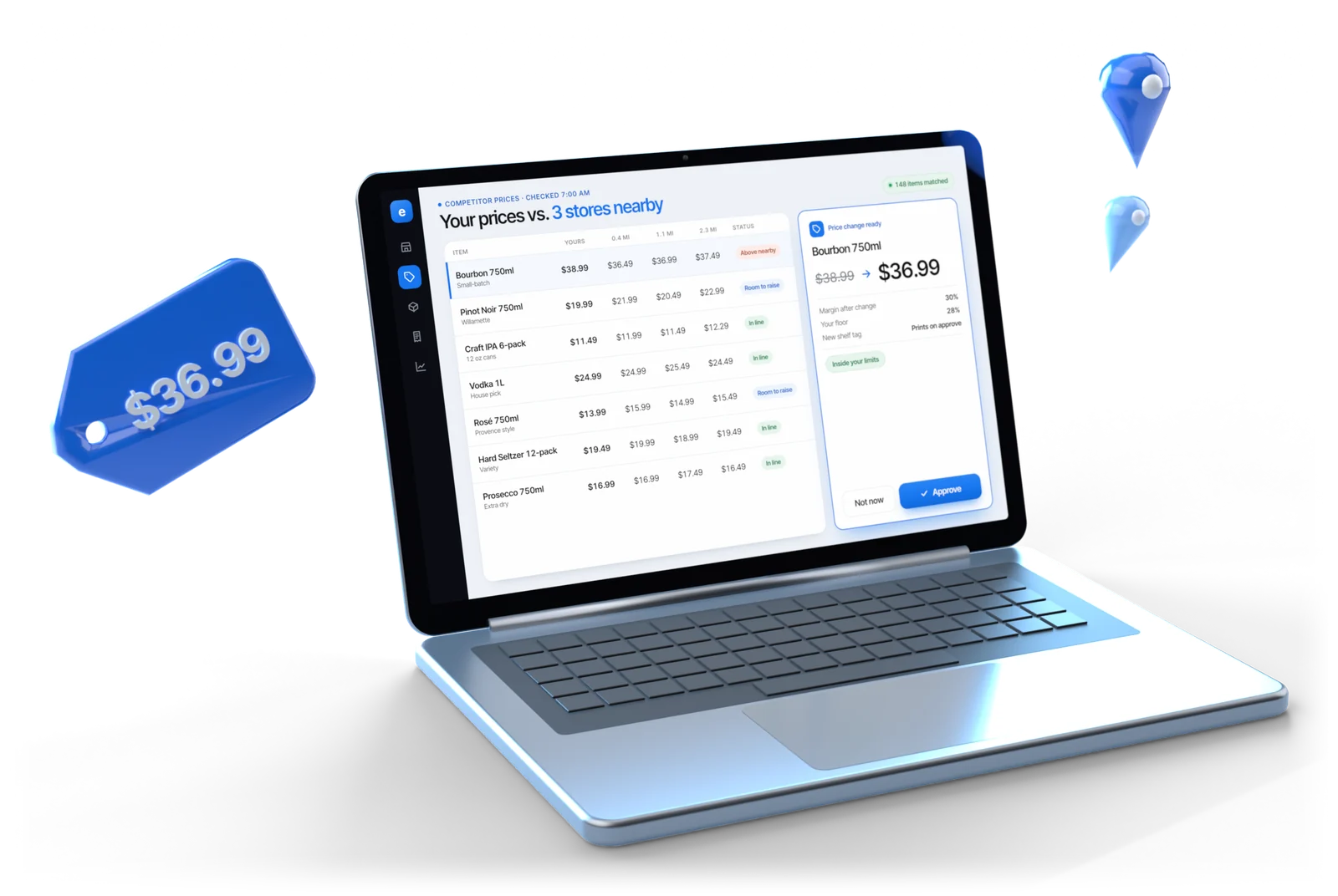
Illustrative example
In short
Retail pricing software works out what each item earns you, shelf price minus the real current cost, and tells you which prices are wrong. Esplanda takes that cost from the deliveries you receive, so the margin is this week's, not last spring's.
It ranks the stale tags, writes the reprice inside your floors and price rules, and measures afterwards whether the change made money.
- Margin from received cost
- Stale tags ranked
- Floors and price endings
- Reprice in one tap
- Measured afterwards
Real cost
Margin against the cost you actually paid
The whole thing stands or falls on the word “real”. A margin report built on six-month-old costs is a confident-looking work of fiction.
- Cost from the back door. Esplanda takes cost from received deliveries, including any correction found when the invoice was matched line by line. If a supplier raised a bourbon from $18.40 to $19.75 on Tuesday's delivery, Thursday's margin uses $19.75.
- Receiving feeds pricing. That link is the part most systems leave to you, and it is where the accuracy comes from. Invoice scanning software keeps it fed.
- Per item, category and supplier. So the problem is not “spirits”; it is eleven specific bottles from one distributor.
Stale shelf tags
The leak hiding in one-cent steps
A stale shelf tag is a price that was set against a cost you no longer pay.
- The most common margin leak. It is invisible in a monthly profit figure, because it is spread across hundreds of items in one-cent steps.
- Costs move one item at a time, in the middle column of an invoice, on a delivery that arrived in a rush. The tag stays put, and six months later a top-twenty item sells on a margin you never agreed to.
- Ranked by units sold, not percentage. A two percent cost rise on something you sell forty times a week outranks a twenty percent rise on something you sell twice a year. The morning list is short and in the right order.
Illustrative example
Repricing
How a reprice gets made
Recommendations come batched: one list a week that is worth walking the aisle for, not four items on Tuesday and three more on Wednesday.
Start from the real cost
The latest received cost for that item, corrected at receiving.
Compare with the shelf
The current shelf price, and the margin you were aiming for when the price was set.
Check the item's role
Is it something customers price-check, or something nobody compares? The answer changes the recommendation completely.
Apply your rules and floors
Category floor margins, brand rules, price endings and any legal minimum in your state.
State the effect in dollars
“Move from $25.99 to $26.99; at last month's volume, about $54 a month more gross profit” beats a percentage.
Send it or hold it
Approve it in one tap, or let Esplanda apply it inside the floors you set once. Anywhere near a floor, it always waits for your tap.
Rules and floors
The pricing you won't break
Your floor margin is a hard boundary, however much of the pricing work you hand over. No price is recommended or applied below it, including when a competitor sells below your cost.
Category floors
A different minimum margin for spirits than for mixers or a deli counter.
Price endings
Everything lands on .99, or .49 and .99, or whatever your shelf tags have always done.
Brand and supplier rules
Items you will not move, and items where a supplier program constrains you.
Maximum move size
No single change larger than the percentage or dollar amount you set, without your approval.
Legal minimums
Where your state sets a floor on alcohol pricing, it is entered once and never crossed. Liquor store software users usually set this first.
Every change logged
Each price change is saved with the reason it was made, whether you tapped it or it moved inside your rules.
Rules are the difference between software that helps and software you end up fighting. Set them once, and the recommendations that reach you are ones you can act on without a second thought.
Nearby prices
When the reason to move is down the road
Nearby prices decide which items you cannot afford to be high on. Margin decides how much room you have to respond. Esplanda holds both.
A price-watching tool alone
Tells you that you are $1.40 above the store on the corner, and leaves you to work out whether you can afford to care.
A margin report alone
Tells you an item earns 24% and leaves out that it is the one item every customer checks before deciding your store is expensive.
Esplanda
A move driven by a nearby price reaches you only when customers really compare that item and the new price still clears your floor.
Margin from your received costs runs in Esplanda POS, which is free. Watching nearby shelf prices is Competitor Intelligence, our price monitoring software, at $299 per location per month: which stores, which sources and how often are on competitor price tracking. Every line is on Esplanda pricing.
On the record
Did the price change make money?
Every price change Esplanda recommends is stored with what it predicted, then measured against what actually happened.
Before and after
Units sold and gross profit for that item, over a comparable period, with the items around it checked in case the basket moved rather than the item.
Every result recorded
An increase that cost volume and a cut that defended nothing go in the record with their real number. A record that only keeps its wins is a brochure.
Noise kept out of the total
A slow mover in a single week, a storm or a local event can swamp a small move. Those changes are marked as not measurable and kept out of the dollar total. See how we measure results.
Where the price lives
Keep the register you have, or use ours. With Esplanda POS, free, an approved price is live at the counter at once: no export step, no drift and no doubt about which system holds the right price. Esplanda also connects to Square, Clover, Lightspeed and KORONA with no change at the counter, pushing approved prices to that register and keeping its products matched; see POS integration. The cost side is fed by retail inventory management software and purchase order software.
Questions
Pricing and margin questions owners ask
How do I know my real margin on each item?
You need the current shelf price and the cost you actually paid for the units you are holding now, not the cost from the last time anyone checked. Esplanda takes cost from received deliveries, including any correction found when the invoice was matched, and works out margin per item, per category and per supplier from that.
Why is my margin lower than I think it is?
Almost always because costs moved and prices did not. Supplier increases arrive one item at a time, buried in the middle column of an invoice, and the shelf tag stays where it was until someone notices. On a catalog of a few thousand items that drift is invisible in a monthly profit figure, but very visible item by item.
What is a stale shelf tag and how do I find them?
A stale shelf tag is a price that was set against a cost you no longer pay. You find them by comparing every item's current cost with the cost in force when its price was last changed, and ranking the gaps by units sold. Esplanda does that continuously and shows the worst first, because a two percent cost rise on a top-ten item matters more than a twenty percent rise on something that sells twice a year.
Will pricing software just tell me to raise prices?
No. Esplanda recommends increases where cost has moved and nobody is watching, and decreases where you are above the local market on something customers actually price-check. On most catalogs the increases on unchecked items are worth more than the reductions on checked ones, but both appear.
Can I set a minimum margin the software can never go below?
Yes, and it is a hard boundary however much of the pricing work you hand over. You set an overall floor margin, and a different floor by category if you like. No price is recommended or applied below that floor under any circumstance, including when a competitor sells below your cost.
Can it change prices automatically?
Yes, within your floors and price rules, if that is how you set it up. Leave it on approval instead and every price change waits for one tap. Either way, a move that would cross a floor becomes an approval request, and every change is logged with the reason it was made.
How do I know whether a price change actually made money?
Compare units sold and gross profit for that item before and after the change, over a comparable period, and check the items around it in case the basket moved rather than the item. Esplanda stores each price change with its prediction and then measures the actual result. A change on a slow mover or in a noisy week is marked as not measurable and kept out of the dollar total.
Does pricing software work with my existing register?
Both ways. Keep the register you have, or use ours. Esplanda POS is free and the better path for pricing, because an approved price is live at the counter at once, with no export and no drift. Esplanda also connects to Square, Clover, Lightspeed and KORONA, and pushes approved prices to that register. Margin from received cost runs in the free Esplanda POS; watching nearby prices is Competitor Intelligence, $299 per location per month.
Find out where your margin went
Start free today, or book a demo and we'll walk through your stale tags, floors and first reprice list on a store like yours.
See what nearby stores charge first with the free price check. Part of a buying group? See rebate management software.