
Holiday and event planning
A retail marketing calendar that plans 120 days ahead
For every holiday and event, Esplanda lines up the order, the shifts, the promotion and the posts while there's still time.
Nothing is bought, posted or scheduled without your approval, unless you set limits for Esplanda to act inside. Read why Esplanda is safe to trust.
Illustrative example
In short
Esplanda's retail marketing calendar lists the dates when demand in your store will do something other than normal, from Thanksgiving and Diwali to a home game or a heatwave, ordered by the money each one moves.
Each date becomes a plan: the buy, the staffing, the price and promotion, the posts and email, the display and a final check, each due on the day it still works.
- 120-day calendar
- Lift by category
- Orders drafted ahead
- Shifts proposed with notice
- Weather that turns into action
- Tastings measured
What goes on the calendar
Seven kinds of date, one calendar
Each occasion carries a date, an expected effect by category and a lead time. Movable dates are worked out for you every year, and a date that depends on observation shows its margin on its face.
| Kind | Examples | Where the date comes from |
|---|---|---|
| Fixed holidays | Independence Day, New Year's Eve, Christmas Eve | The calendar date |
| Movable feasts | Easter, Passover, Eid al-Fitr, Diwali, Lunar New Year, Thanksgiving, Mother's Day | Published rules or a reference table, worked out for any year |
| Sporting fixtures | Super Bowl Sunday, the local team's home games | Fixture data |
| Local events | A concert, a high school football game, a graduation, a parade | Ticketing feeds, city and school calendars, or entered by you; scored by distance as well as size |
| Weather episodes | A heatwave, a cold snap, a nor'easter, the first warm weekend | National Weather Service data against a ten-year local normal |
| Economic rhythms | The 1st, the 15th, month end, local pay cycles, benefit dates | Rules, including state issuance schedules |
| Your own events | The store anniversary, a club night, a standing tasting | You enter it once and it recurs |
Each occasion's lift is a range per category from your own sales history, with the number of past instances on the card. A first-time occasion borrows an anonymous figure from comparable businesses, labeled as borrowed, until your own history takes over. Categories that dip show as dipping, so you buy the right half of the store.
An occasion is a project
Counted back from the date
Each step goes to the part of Esplanda that owns it, and a step is only proposed while it can still be done.
The buy, weeks out
Sized from the lift and your own sell-through, drafted as a purchase order with case counts and a total, with what it does to your cash and a smaller version to approve instead. See purchase order software.
Staffing, about two weeks out
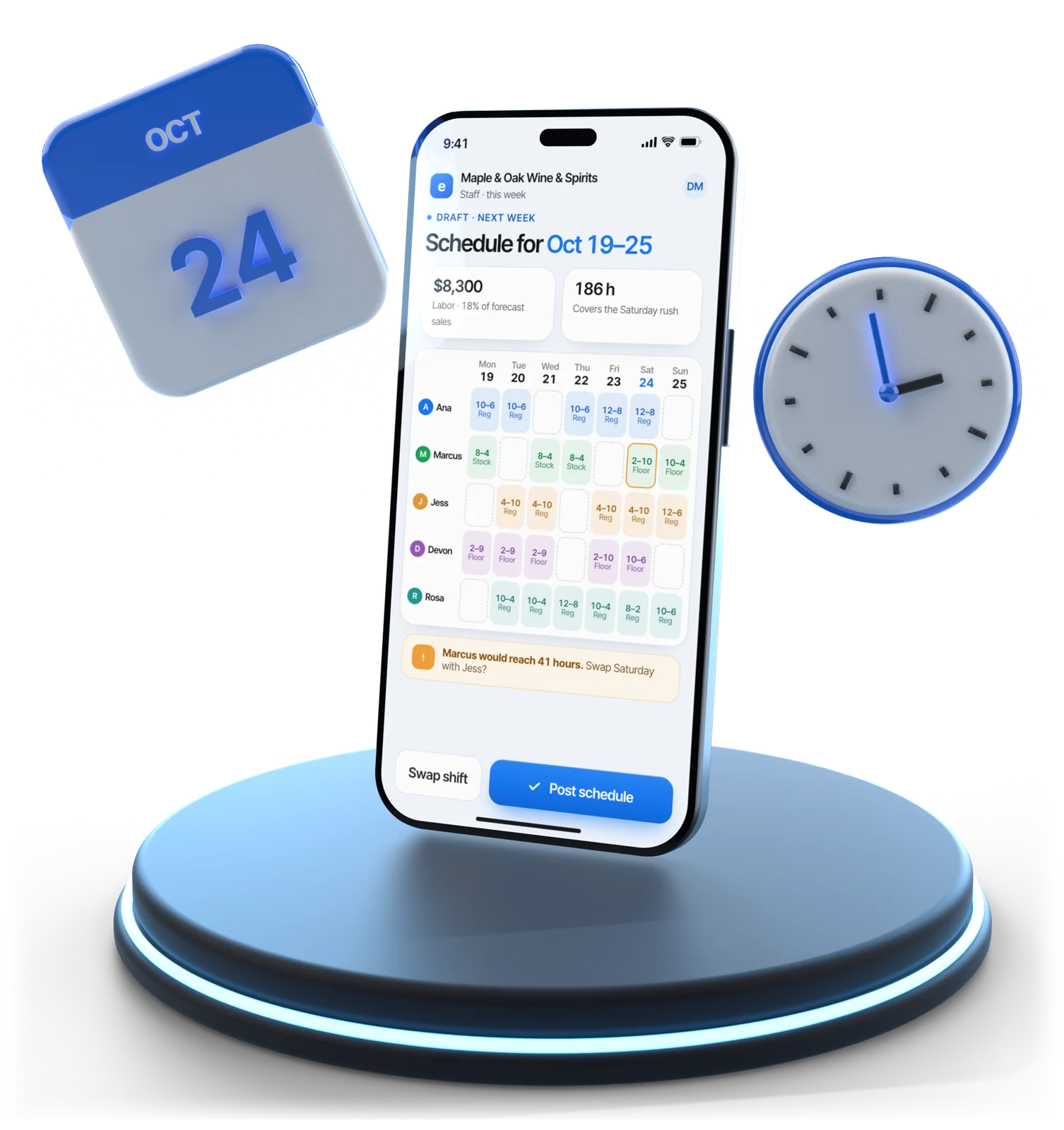
A proposed shift change with enough notice for people to plan around it, in your employee scheduling software.
Price and promotion
The price ladder and the multi-buy, set before the posts that have to describe them.
Posts and email, about ten days out
Drafted with the promotion terms already in them, through marketing automation for small business.
The fill-in buy, on actuals
A second order against what has really sold since the first, not against last month's guess.
The display and the final check
The endcap and floor stack a few days out, then stock, staff, hours, ice, bags and change the day before.
Weather
Weather that becomes a purchase order
Esplanda checks whether anything can still be done before the weather arrives: the supplier's cutoff, the notice a shift needs, the time a display takes. If something can, it is drafted.
| Situation | What Esplanda does | Why |
|---|---|---|
| Storm Thursday, supplier cutoff this afternoon | Drafts a fill-in order by category, ready to approve | The order clears the lead time with hours to spare |
| Storm Thursday, next truck Monday | Marks the calendar quietly, with no alert | An alert you can't act on only costs you attention |
| Storm Thursday, cutoff passed, floor is yours | Proposes the display move and the staffing change | Both have short lead times of their own |
| A warm weekend ten days out | Proposes a seltzer and light-lager fill-in and a display swap | A two-day supplier lead time fits easily inside the window |
Weather lift is modeled by category and by kind of weather, so a cold snap moves whisky and a heatwave moves seltzer. The same lift feeds our demand forecasting software, so there is one forecast in one place.
Tastings and in-store events
Tastings chosen on numbers, then measured
A tasting is a marketing channel with a return you can count. Esplanda picks what to pour and when, then records what it earned. More on our liquor store software.
Chosen on numbers
- What to pour, from the product's margin, your stock of it, any supplier co-funding and how it sold the last time it was poured.
- When to pour, from your own foot-traffic curve, built from sale timestamps.
- What is allowed, from your pouring permit, its expiry and the sampling rules your state sets, checked before a tasting is scheduled.
Measured afterwards
- Units sold on the day and for fourteen days after, against what those days would normally bring.
- Costs netted off: the product poured, the staff hours and the supplier's contribution.
- The result recorded in dollars, and a pairing that lost money is not proposed again.
Occasions are picked from the sales lift measured in your own data and the switches you set. Esplanda never infers anyone's religion, ethnicity or national origin.
Questions
Holiday and event planning questions owners ask
What is a retail marketing calendar?
A retail marketing calendar lists the dates when demand in your store will move, such as holidays, local events, weather and paydays, with the promotions, posts and stock each one needs. Esplanda builds one for the next 120 days, gives every date an expected dollar lift and orders the list by money rather than by date.
Which holidays and events does Esplanda plan for?
Fixed holidays, movable religious and cultural feasts, sporting fixtures, local events, weather episodes, economic rhythms such as paydays, and your own recurring events. Movable dates such as Easter, Passover, Eid al-Fitr, Diwali, Lunar New Year and Thanksgiving are worked out from published rules rather than typed in by hand.
How does Esplanda know what a holiday is worth to my store?
From your own sales history against a matched baseline, as a range per category. Beer might run well above a normal week while wine sits below it. With few past instances the estimate leans toward comparable businesses, so one unusual year can't drive a large order, and the number of instances behind each estimate is shown.
What happens the first time an occasion comes round?
Esplanda uses a figure borrowed from an anonymous group of comparable businesses and labels it as borrowed. The group is only formed above a minimum number of businesses and carries no business names. Once your own history exists, it takes over and the change is visible.
Does Esplanda order the holiday stock itself?
Only if you tell it to, and only inside the limits you set once. By default it drafts the order with the case counts and the total, sets out the case for and against it, including what it does to your cash, and offers a smaller version. You choose, for each kind of work, whether Esplanda advises, prepares the work for one-click approval or acts inside your limits.
What does Esplanda do about the weather?
It turns weather into an action while there is still time: a fill-in order before the supplier's cutoff, a shift change with notice, or a display move. Weather that is too close to act on goes on the calendar as a quiet marker, with no alert.
How are tastings chosen, and how do I know one worked?
Esplanda proposes what to pour from margin, stock, supplier co-funding and past results, and schedules it against your own foot-traffic curve. Afterwards it measures units sold on the day and for fourteen days after against a matched baseline, nets off the costs and records the result in dollars.
My town is small. Will the calendar still have events?
Yes. Holidays, weather and paydays need no local feed and carry most of the money on most calendars. Add a local event yourself, such as the church fair, the parade or the county fair, and it drives a plan exactly like any other date.
What does holiday and event planning cost?
Demand forecasting and purchase orders, which the calendar feeds, are part of Esplanda POS, which is free, with no setup fee and no contract. The posts and email steps run in Marketing — Do It Yourself and the shift changes in Employee Scheduling & Attendance, each a paid tool you add on its own, per location per month. Every price is on Esplanda pricing.
See what the next 120 days are worth
Start free today, or book a demo and we'll build the calendar for a store like yours.
Esplanda POS and your website are free to start, with no card needed. Add paid tools only when you want them. See Esplanda pricing.