
Delivery app integration
Third-party delivery integration from one menu
Esplanda keeps DoorDash and Uber Eats in step with your menu and stock, and puts every delivery order in your counter queue.
Delivery app sync is Marketplace Connectivity: $69 per location per month, for prepared food, from $2,000 a month of delivery revenue. Esplanda POS is free. See Esplanda pricing.
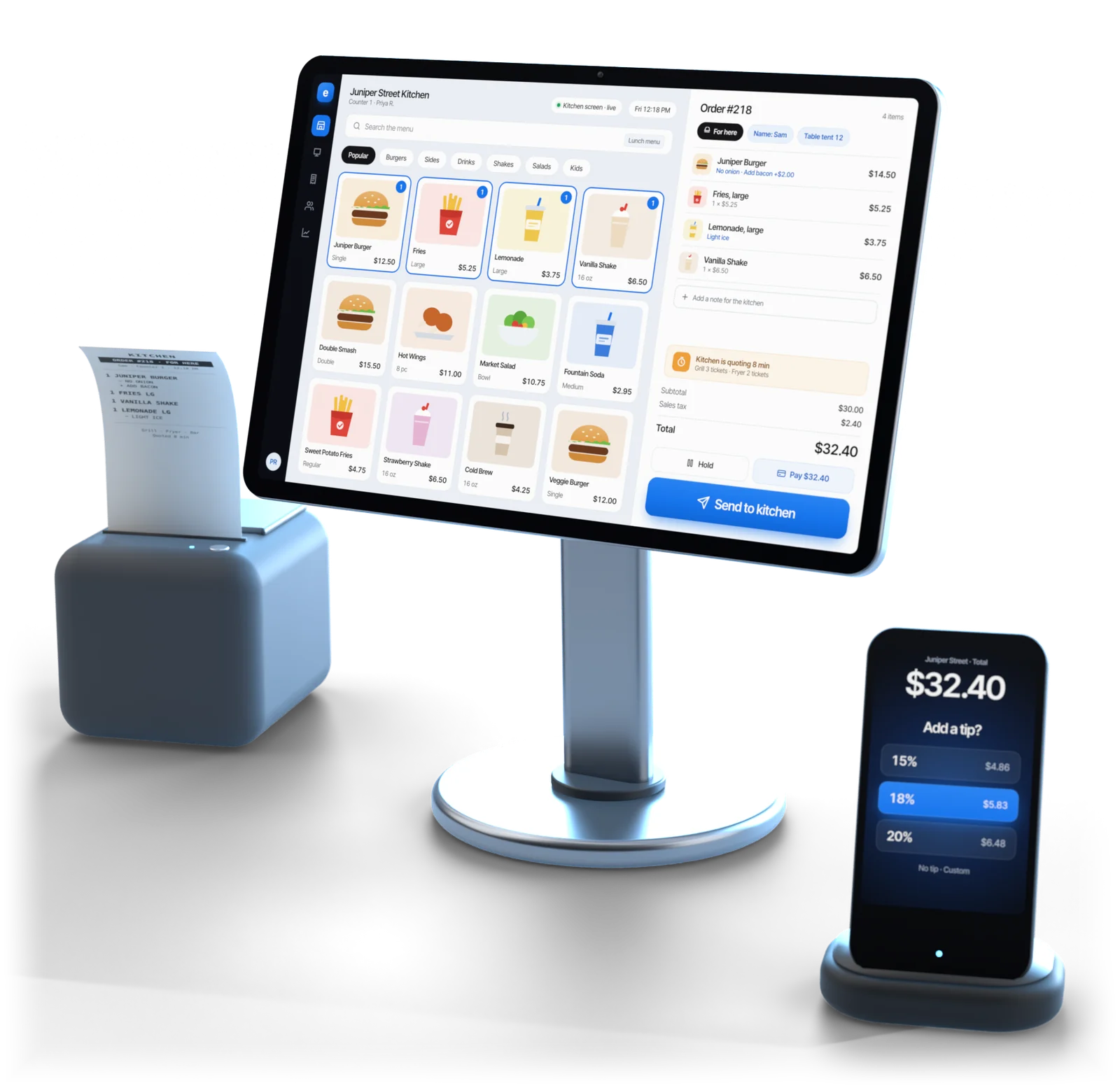
Illustrative example
In short
Third-party delivery integration connects the delivery apps you already sell on to the system that holds your real menu and stock. With Esplanda, one menu record feeds DoorDash and Uber Eats, sold-out items come down on both by themselves, and every delivery order joins your counter and online orders in one queue.
Each app gets a price you set on purpose, checked against its commission and your floor margin, and your profit and loss shows what each app really earns after its fees.
- One menu, two apps
- Stock-driven availability
- Per-app pricing
- One order queue
- Margin after commission
The problem
Two apps, two menus, and both drift
Every delivery app holds its own copy of your menu. It gets set up once at signup and then slowly goes stale: last spring's prices, a dish you dropped in March, holiday hours right in one place out of two.
| What goes wrong | What it costs you | What Esplanda does |
|---|---|---|
| Menu drift | Wrong prices, missing new items, dropped items still listed | One menu record, pushed to both apps, kept up once |
| Stale availability | Cancellations, refunds and a hit to your rating | Live stock takes sold-out items down and puts them back when stock arrives |
| Set-and-forget pricing | Commission absorbed quietly for years | A deliberate price per app, checked against your floor margin |
| A tablet per app | Staff time, missed orders, wrong hours | One order queue, one hours setting, one pause switch |
| No margin per app | No way to tell which app is worth keeping | Margin per app after commission, in your profit and loss |
The last row is the one owners underrate: margin after commission, in your expense tracking software for small business, decides whether an app stays, not its order count.
How it works
How the delivery apps get connected
Connect the DoorDash and Uber Eats accounts you already have. Your agreements, your commission rates and your payouts stay exactly as they are.
Connect your accounts
Link the delivery app accounts you already hold. Nothing about your merchant agreements changes.
Push one menu
Items, descriptions, sizes and photos kept once in Esplanda and sent to both apps, instead of edited twice.
Let stock drive availability
Out of stock, off the apps. Back in stock, back on. When something sells out at 4pm, the listing knows.
Set delivery prices on purpose
A price per app that covers its commission and still clears your floor margin. Esplanda proposes it; you approve it, inside retail pricing software limits you set once.
Work one order queue
Delivery orders join in-store, phone and POS with online ordering orders on one list, each one taking from the same stock count.
See margin per app
Margin after commission for each app, so keeping or dropping one is decided on a number.
Commission and margin
A delivery price is not a shelf price
Commission is a real cost of the delivery channel. The money is made by pricing that channel deliberately, not by pretending the fee isn't there.
- The common pattern. A store mirrors its shelf prices onto the apps because it feels fair, then pays the commission out of a margin that was already thin. Two years and two cost rises later, some items sell below break-even.
- The Esplanda way. Landed cost, plus your floor margin, plus that app's commission and fees, then checked against comparable sellers on the same app. Esplanda does that sum per item, per app, and proposes the price.
- Your commission stays yours. Your rate is set in your agreement with each app. Esplanda puts the fee in your margin figures and prices each app against it.
You approve every delivery price before it goes live.
Your register
One menu needs one source of truth
Something has to hold the true menu and the true stock count. That is the register. Keep the one you have, or use ours: both work.
Esplanda POS, free
The delivery menus run on the same live stock and prices as the counter: no nightly export, no matching queue, no reconciling at close. See the free POS system.
Or keep your register
Esplanda connects to Square, Clover, Lightspeed and KORONA with no change at the counter, matching products as they appear. See POS integration.
Delivery sales count toward buying
What sells through the apps feeds demand forecasting software and your purchase orders, so an item that moves on delivery gets bought for.
Your own storefront beside the apps
Orders from your own site take no marketplace commission. Many stores run both and measure each channel separately.
Built for
Built for kitchens that sell on the apps
If a kitchen makes it and a courier carries it, delivery app integration has a job to do.
Built for
- Restaurants, full-service, pizza and quick service, where specials change daily; see restaurant management software and the restaurant POS system.
- Cafés and bakeries with a short menu that sells out by mid-afternoon.
- Delis, hot bars and sandwich counters inside a grocery or convenience store, with only the prepared food on the apps.
- Caterers with a daily menu or a retail side.
- Multi-location operators running one menu across several kitchens, with margin per app at each site.
Works with what you have
- Your app accounts: your agreements, commission rates and payouts stay yours.
- Your register: Esplanda POS, or the Square, Clover, Lightspeed or KORONA register you keep.
- Your rules: the item categories, hours and delivery zones you set are applied on every app. For alcohol, delivery rules are set by your state and license, and Marketplace Connectivity is offered to alcohol sellers after legal review.
Questions
Delivery app questions owners ask
What is third-party delivery integration?
It connects the delivery apps you sell on to the system that holds your real menu, prices and stock. With Esplanda, one menu record feeds DoorDash and Uber Eats, availability follows your live stock, and every delivery order lands in the same queue as your counter and online orders.
Can I manage DoorDash and Uber Eats from one place?
Yes. Esplanda keeps one menu and pushes items, prices and availability to the DoorDash and Uber Eats accounts you already hold, and brings every order into one queue with your other orders. You keep your merchant agreements and payouts, and you stop editing two dashboards by hand.
How do I stop selling items on DoorDash that I'm out of?
Let your stock count drive availability. When an item runs out, Esplanda takes it down on every connected app and puts it back when stock arrives. Sold-out items left listed are the main cause of cancellations, refunds and rating damage.
Should my delivery app prices be higher than my in-store prices?
Usually, yes. Commission is a real cost of the delivery channel, so a shelf price copied onto an app hands a slice of every order away. Esplanda works out a price per item, per app, that covers the commission and still clears your floor margin, and you approve it before it goes live.
Can Esplanda get me a lower commission rate?
Your commission rate is set in your agreement with each app, and it stays between you and that app. What Esplanda does is put the fee in your margin figures, price each app against it and show your margin per app after commission, so you can decide on a number which apps are worth keeping.
Does delivery app integration work with my POS?
Yes, both ways. Esplanda POS is free and is the simplest path, because the delivery menus run on the same live stock and prices as the counter. Keeping a Square, Clover, Lightspeed or KORONA register works too: Esplanda connects to it with no change at the counter.
How much does delivery app integration cost?
Delivery app sync is Marketplace Connectivity: $69 per location per month, for prepared food, sold to businesses with at least $2,000 a month of marketplace and delivery revenue. Esplanda POS is free, and there is no setup fee and no contract.
Can I deliver alcohol through these apps?
Alcohol delivery rules are set by your state, your municipality, your license and each app, and they change. Marketplace Connectivity is offered to alcohol sellers after legal review. Your own storefront takes pickup and local delivery orders inside the hours and zones you set.
See what delivery really earns you
Start free today, or book a demo and we'll walk through your delivery apps: the menu, the prices and the margin each app leaves you after commission.
Esplanda POS and your website are free to start, with no card needed. Add paid tools only when you want them.