
Competitor price tracking
Competitor price tracking for the stores near you
Esplanda reads nearby shelf prices, shows where you're high on items shoppers compare, and drafts a new price above your floor.
The price check is free, with no credit card. Competitor price tracking is Competitor Intelligence, $299 a month per location, and Esplanda POS is free. How far it goes on its own is a setting you choose. See how Esplanda works.
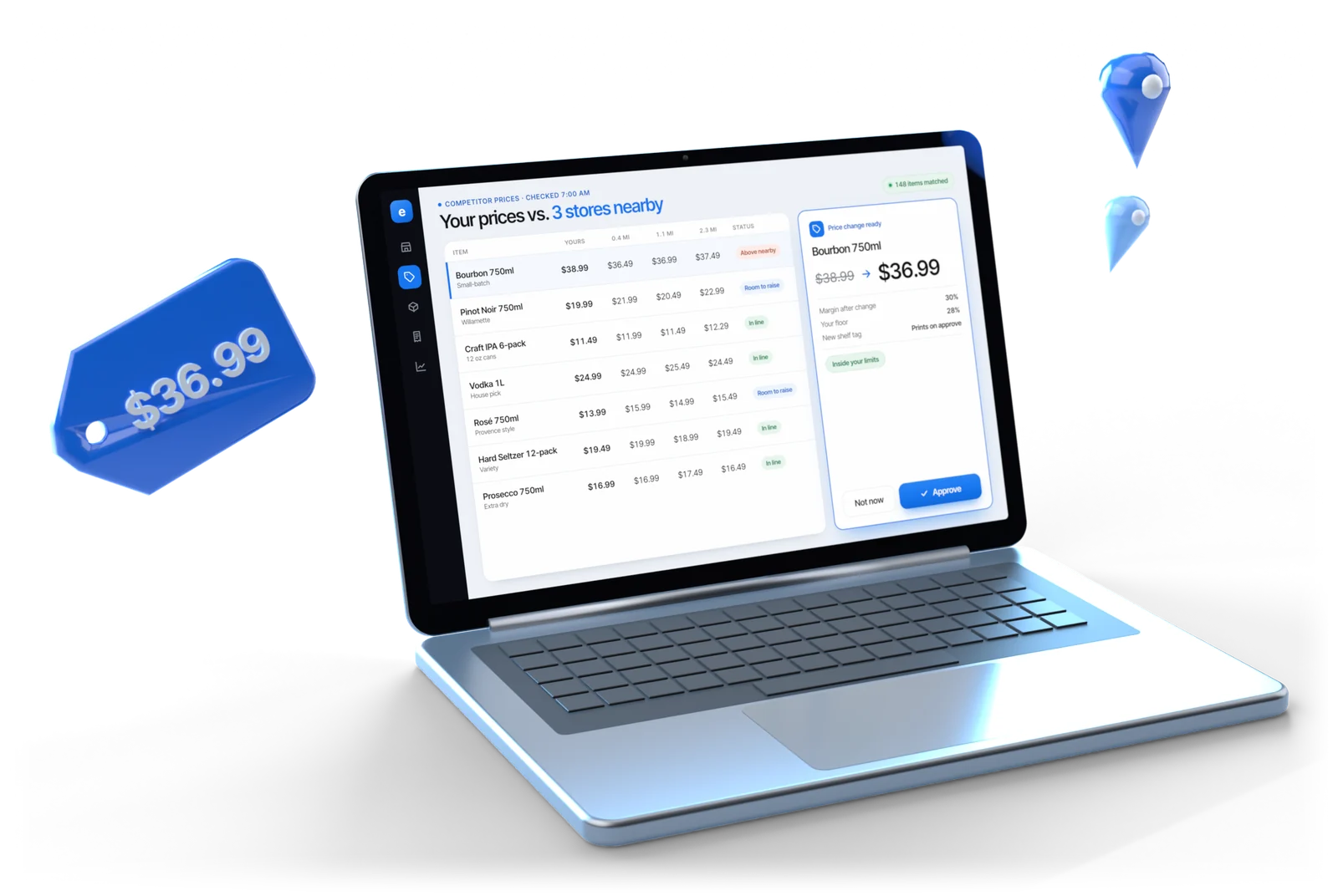
Illustrative example
Your price image
Sharp where it counts, margin everywhere else
Shoppers don’t compare your whole shelf. They know what a few favorites cost, and if you’re high on those, you’re “the expensive store”, whatever the rest costs. Esplanda sorts your catalog into four groups.
- Shoppers compare these
Watch closely
The familiar, often-bought items that shape your price image. Stay sharp here and check often.
- Nobody compares these
Hold margin
Price them for margin, not for the shelf next door.
- Below the stores near you
Under-priced
A modest rise that costs you no sales, and the group owners tend to miss.
- Well above the market
Exposed
Items people check where you’re high, with what not acting is likely to cost.
Competitor price monitoring, without the Sunday drive
- Store websites
- Delivery app listings
- Published promotions
Every nearby price carries the day it was seen, so an old number never passes for a fresh one. It’s built for liquor and wine stores: a liquor store is where catalogs overlap heavily and customers price-check known bottles.
Want a one-time look first? A free competitor price comparison compares 5 products at up to five comparable stores near you, once, without connecting anything, and shows them free, straight away. Competitor price tracking is the ongoing version: your whole catalog, up to 2,000 matched products, against six nearby competitors, refreshed daily, with your own costs behind every price.
Price monitoring
How to track competitor prices, three ways compared
Pick the stores your shoppers compare you with and the items they check, then record each price with its source and date beside your own cost. Here’s how the three usual ways do that.
| Question | Walking other stores | Online price tracker | Esplanda |
|---|---|---|---|
| What it watches | The shelves you have time to visit | Product pages you pick, mostly web shops and marketplaces | Published prices of the stores near you: websites, delivery app listings and promotions |
| How fresh | The afternoon you walked | As often as it checks each page | Refreshed daily, every price with its source and the day it was seen |
| Same product? | Whatever you wrote down | Depends on how each page is matched | Every row is the same product, size and pack at both stores |
| Your cost beside it | Only if you look it up later | Only if you load your costs | The cost you paid this week, from received deliveries |
Your rules
Your floors, never crossed
A competitor’s price shows which items you can’t afford to be high on; your margin shows how much room you have. Esplanda is price tracking and margin management in one.
- Margin floors. One overall, or a different floor for spirits, wine, beer and mixers. No suggestion goes below it, in any circumstance.
- Legal minimum prices. Where your state sets a minimum price for alcohol, it’s entered once and never crossed.
- Your price rules. Price endings like .99 or .49, the items you will not move, and a maximum move size.
- Close calls wait. A move near your floor, or larger than your maximum move size, always waits for one tap. Read why Esplanda is safe to trust.
Alcohol pricing rules are set by your state and license. Enter your minimums once, and every price stays above them.
Margin
Margin against what you paid this week
Every item’s margin comes from the cost you actually paid this week, not the cost from whenever somebody last checked. It’s reported by item, by category and by supplier, so the problem isn’t “spirits” but a few bottles from one distributor.
A stale shelf tag is a price that was set against a cost you no longer pay.
- Costs move quietly. Not in one announcement, but item by item on ordinary deliveries, and the tag stays where it was. Months later a top seller is earning a margin you never agreed to.
- Ranked by units sold. Not by percentage: a small cost rise on something you sell every day comes ahead of a big one on something you sell twice a year.
- Fed by receiving. Costs come from received deliveries, including any correction found when the invoice was checked with our invoice scanning software.
| Item | Cost when priced | Cost now | Shelf price | Margin then / now |
|---|---|---|---|---|
| Bourbon 750ml | $18.40 | $19.75 | $25.99 | 29.2% / 24.0% |
| Imported lager 12-pack | $21.00 | $22.60 | $28.99 | 27.6% / 22.0% |
| Vodka 1L | $14.20 | $14.20 | $19.99 | 29.0% / 29.0% |
| Mixers 24-pack | $9.60 | $10.80 | $13.49 | 28.8% / 19.9% |
How it works
How a new shelf price gets made
Suggestions arrive once a week, as one list worth walking the aisle for.
Read the prices near you
Public shelf prices from nearby stores, each with the day it was seen.
Start from your real cost
The latest cost you paid, including the distributor increase nobody passed on.
Check the item’s role
Is it one shoppers compare, or one nobody checks? The answer changes the advice.
Apply your rules
Margin floors, price endings, your maximum move size, the items you will not move and legal minimums.
Show the effect in dollars
What each change should add to weekly profit at your recent sales, not a percentage. For a bigger move, what-if scenario planning software shows the likely range first.
Approve, then measure
Approve the list and print new labels. Later, Esplanda checks what each change actually earned, in dollars.
Who applies the new price
- Advise only
- Flags where you are off market; you change the price yourself
- One tap
- Hands you each price move; every one waits for one tap
- Inside your floor
- Makes the moves that sit inside your floor and your price rules without asking; anything that would cross the floor becomes an approval request either way
How far Esplanda goes on its own is a setting you choose, and pricing can stay on advise-only at any time. Your state's legal minimum on alcohol prices is never crossed. Competitor Intelligence is $299 a month per location. Keep the register you have, or use ours: on Esplanda POS, which is free, an approved price goes live at the counter right away. See every paid tool on Esplanda pricing.
What to carry
See what nearby stores sell that you don’t
Prices are half the picture. The shelves near you also show what your neighborhood buys.
- Assortment gaps. Items that sell in your area and that nearby stores carry, but you don’t, ranked by what they’re likely worth. A short list, not a catalog. The next step is what nearby stores carry, turned into what you should carry.
- Items to rethink. Things you stock that no store nearby carries and that aren’t moving on your shelf either. That’s often where dead stock starts; see inventory management for small business.
- Every change measured. What each suggested change earned shows up in your business reporting software; see how we measure results.
Every nearby price in Esplanda is one a store really published, with the day it was seen.
Being priced right only helps if shoppers find you. Our AI visibility tool checks whether ChatGPT, Gemini and Perplexity name your store when someone asks where to buy.
Public prices
Public prices only, and your own decisions
What Esplanda does
- Reads what stores publish, on their websites, delivery app listings and promotions.
- Recommends your own pricing, set independently from your costs, rules and goals.
- Shows its sources, with the day each nearby price was seen.
- Measures every change it suggested, so you see what each one earned.
Built to protect you
- Your prices stay yours. Never shared with a competitor, and never coordinated between businesses, including two Esplanda customers on the same street.
- Published prices only. Every nearby price is one a store published, with the day it was seen.
- Your floor holds. No price goes below your floor or a legal minimum price for alcohol.
Looking at prices other stores publish is ordinary competitive research. Agreeing prices with a competitor is not, and Esplanda never does it.
Questions
Competitor price tracking questions owners ask
What is competitor price tracking?
Competitor price tracking means checking, again and again, what nearby stores charge for the items you also sell. Esplanda does it every day from public shelf prices on store websites, delivery app listings and published promotions, shows where you sit item by item, and marks the day each price was seen.
How do I track competitor prices?
Pick the stores your shoppers compare you with and the familiar items they check, then record each price with its source and the date, next to your own cost. By hand that means a store walk every week. Esplanda refreshes the published prices of stores near you every day and shows where you're high and where you can hold margin.
Is it legal to track competitor prices?
Yes. Looking at prices other stores publish is ordinary competitive research. Agreeing on prices with a competitor is not. Esplanda uses public prices only, recommends your own independent pricing, never shares your prices with other stores and never coordinates prices between businesses, including two Esplanda customers on the same street.
Is there price tracking software for a single small store?
Yes. Esplanda's competitor price tracking is priced per location and built for independent stores. It watches the public shelf prices of the stores near you, starts from your own costs and margin floors, and finds the few familiar items shoppers compare, so you stay sharp on those and hold margin on the rest.
Will Esplanda just tell me to cut prices?
No. Just as often it finds items where you're below the stores near you and could charge more without losing the sale. Every suggestion stays above your margin floor and any legal minimum price for alcohol, and a move near your floor always waits for your approval.
What if a competitor sells below my cost?
Automatic price moves never go below your floor. Esplanda shows what not matching is likely to cost you, so the decision has a number on it, and looks for other moves: a similar item you can be sharp on, a bundle, or keeping the basket and letting that one item go.
How often are nearby prices updated?
Daily. Competitor Intelligence refreshes the comparison every day, and each price is only as new as its source: a store's price changes when that store publishes a change. Every price carries the source it was read from and the day it was seen, and a competitor that publishes nothing is reported as a gap rather than filled with a guess.
How much does competitor price tracking cost with Esplanda?
Competitor price tracking is Competitor Intelligence, $299 a month per location, month to month, with no setup fee. That covers six tracked competitors and up to 2,000 matched products, refreshed daily, and an additional competitor set is $9 a month. How far it goes on its own is a setting you choose: it can hand you each price move for one tap, or make the moves that sit inside your floor without asking. Anything that would cross the floor becomes an approval request either way, and no price goes below your state's legal minimum. The free price check on 5 products costs nothing.
Know what the store down the road charges today
Get your free price check to see what comparable stores near you charge, or start free with Esplanda POS.
The price check is free, with no credit card. Competitor price tracking is Competitor Intelligence, $299 a month per location. Price changes wait for one tap, or move inside your margin floor and price rules if you choose.