
Group purchasing
One negotiated price list, distributed to every member and live in every member's purchasing screen, not a PDF that was current in March.
Buying group software
One negotiated price list in every member's purchasing screen, every rebate tracked, and members compared without seeing each other's data.
No group license to negotiate: each member starts on Esplanda POS, free, with no setup fee and no contract.
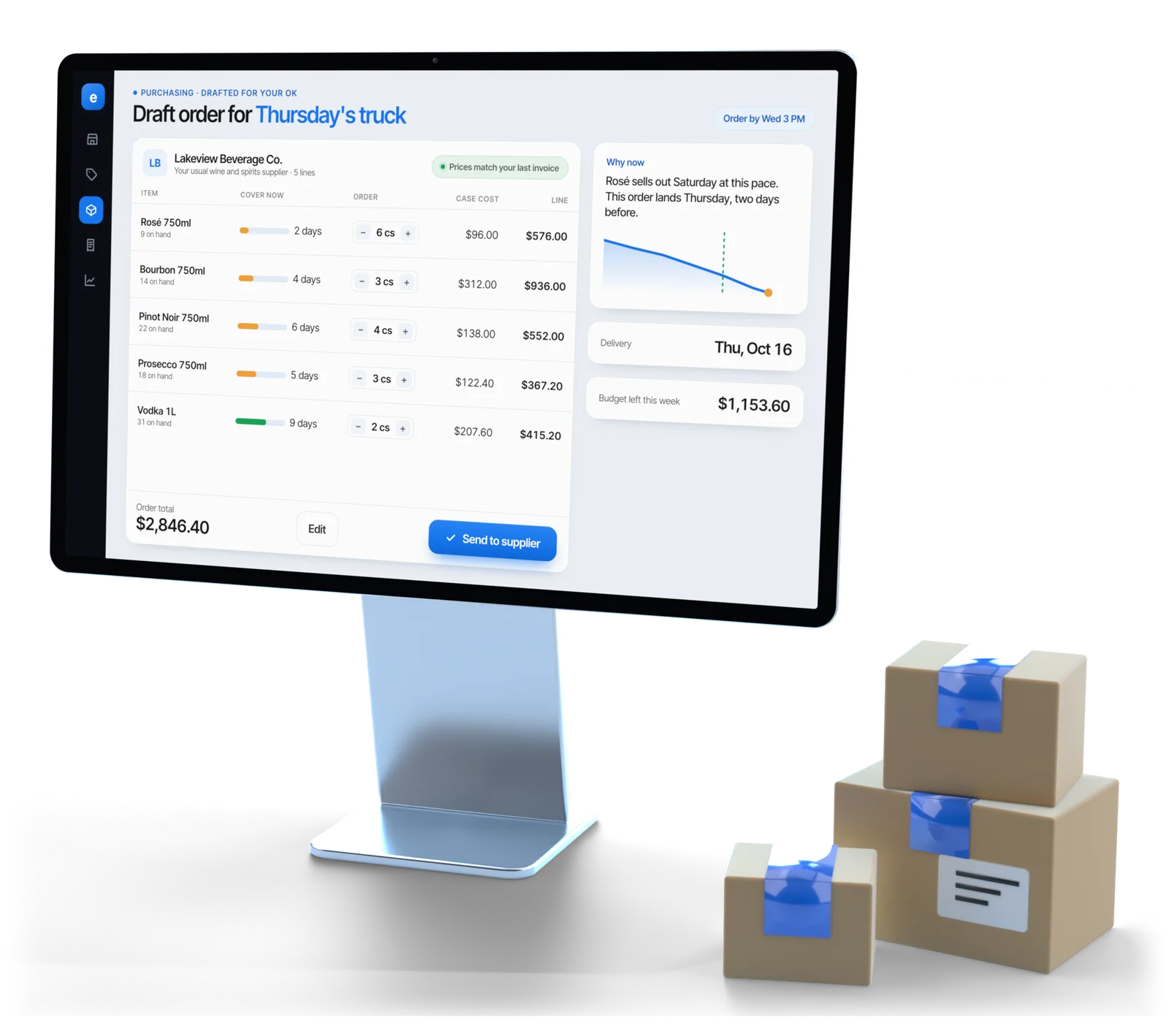
Illustrative example
In short
Esplanda is rebate management software and buying group software in one: one negotiated price list for every member, rebate tracking in all three shapes, a shared assortment a member can deviate from on the record, and opt-in, anonymized benchmarking, all on the catalog the member's register already runs.
A member's competitive data never leaks to a rival member through the group.
What a group needs
Most groups do three of these in email and the fourth not at all: the price list goes out as a PDF, the assortment as a photo of a planogram, the rebates into one person's spreadsheet, and benchmarking never happens because nobody trusts where the numbers would end up.
One negotiated price list, distributed to every member and live in every member's purchasing screen, not a PDF that was current in March.
All three shapes: off-invoice, bill-back and year-end. The third is the one groups most often reconcile wrong, and where the most money is left on the table.
The group sets the planogram. The member who knows their street can deviate, and the deviation is recorded, not blocked.
Opt-in, aggregated and anonymized. A member sees where they sit in a range, and nobody sees who anybody else is.
Group purchasing
The group office publishes the negotiated supplier list once, and every member's purchasing screen reads from it. When a supplier price changes, it changes in one place.
Rebate tracking
Two of the three rebate shapes never touch an invoice. Claiming them means knowing exactly what sold and what was received, by product, by supplier, across every member, for twelve months: a reconciliation nobody wins with a spreadsheet.
| Rebate shape | How it is earned | Where it goes wrong | What Esplanda does |
|---|---|---|---|
| Off-invoice | A discount applied on the supplier bill | Quietly dropped on a later delivery, and nobody checks | Every invoice line matched to the negotiated price at receiving |
| Bill-back | Earned on purchases or sales, claimed after the fact | The claim is built from memory; short-paid claims go unchallenged | Accrues per qualifying line as it happens, to a running balance |
| Year-end | Volume or growth tiers measured over the year | Tier position unknown until it is too late to reach the next one | Position tracked all year, by member and group-wide |
Month nine
The effect is not a better claim letter. In month nine the group office can see which tier is within reach and tell members what it would take to get there, with a quarter still left to do it. Margin work downstream of that sits in retail pricing software.
Member privacy
No. A member's competitive data never leaks to a rival member through the group. That is the rule, not a preference setting. Two members on the same street are competitors before they are members.
A member who says nothing is in nothing. Nobody is opted in by default.
Participating data is pooled before anyone reads it, so a comparison is against a pooled figure, never against a store.
A member sees their position in a range, not a leaderboard with names on it.
The group office sees the pooled view it needs to negotiate. No member ever sees another named member's margins, costs or customer data, whether or not either opted in.
| Data | The member | Another member | Group office |
|---|---|---|---|
| Their own sales, costs and margins | Full | Never | Group-level only |
| Their customer list | Full | Never | Never |
| The group's negotiated cost list | Full | Full | Full |
| Their retail prices | Theirs to set | Not through the group | Group-level only |
| Benchmark position | Own position in an anonymized range | No named members | Aggregated ranges |
| Rebate accruals | Own balance | Never | Own and group totals |
| Assortment deviations | Own | Never by name | By store, for assortment work |
You do not need a group to get a benchmark. The same cohort machinery, with minimum contributor counts and suppression of any cell one large member could be read out of, runs for independent stores that belong to no group, and a comparison is published only when it is fair: see retail benchmarking. How Esplanda handles changes, stop switches and data export for every merchant is on why Esplanda is safe to trust.
Getting started
Six steps, and the first involves a handful of members rather than all of them. A rollout members chose survives the first disagreement; a mandated one rarely does.
Across different trading conditions: a busy one, a quiet one, a suburban one, a city one.
Into the group catalog, with the rebate agreements attached to the products and suppliers they cover.
And tell members plainly that deviating is allowed and recorded.
Every delivery is matched against the negotiated price, and variances surface the same day.
One at a time, with the who-sees-what table in front of them.
To the whole group: a number somebody can check is the rollout argument that works. Members with several stores get the same view across their own: see multi location inventory management.
What it costs
A group can start with six members and add the rest when the six have something to report.
Questions
It is the system a co-op, voluntary chain, franchise or banner uses to push one negotiated price list out to every member, track the rebates those agreements earn, publish a shared assortment, and compare members without exposing them to each other. Esplanda does all four on the same catalog the member's register already runs on, which is why the group's numbers and the store's numbers agree.
Every rebate agreement is held against the products and suppliers it covers, so each qualifying sale or receipt accrues the amount owed as it happens. Off-invoice rebates are checked against the price actually billed. Bill-back and year-end rebates accrue to a running balance the group office and the member can both see, which turns a year-end claim from an argument into a reconciliation.
No. A member's competitive data never leaks to a rival member through the group. Benchmarking is opt-in, aggregated and anonymized; the group office sees group-level numbers; no member ever sees another named member's margins, costs or customer data. Two members on the same street are competitors before they are members, and the software is built on that.
Yes. The group sets the assortment and the planogram; the member who knows their street can deviate, and the deviation is recorded rather than blocked. The group office sees what was changed and where, which over a season is the most useful assortment research a group can get.
No. The group negotiates and distributes cost, one supplier price list to every member, and can publish recommended retails. The retail price a member charges stays the member's decision, and Esplanda records it as theirs. Cost is a group matter; the shelf edge belongs to whoever pays the rent.
No, and a group of any size rarely gets unanimity anyway. Esplanda POS is free and the better path, because there is then one catalog. Members who want to keep a Square, Clover, Lightspeed or KORONA register can connect it instead and still receive the group price list and rebate tracking.
There is no group license and no group rate to negotiate: each location pays the published price on the Esplanda pricing page, with no setup fee and no contract, and every member's Esplanda POS is free. Groups usually start with a handful of willing members rather than a mandate, because a rollout that members chose survives the first disagreement.
Yes. A franchise or banner can publish the assortment as mandatory and see every deviation against it, store by store, without waiting for a field visit, so compliance is visible the same week rather than at the next audit. One franchisee's data still never appears inside another franchisee's screen.
Start free today, or book a demo and we'll walk your group office through the price list, the rebate balances and the who-sees-what table.
Esplanda POS and your website are free to start, with no card needed. Add paid tools only when you want them.