
Ask your business a question
AI retail analytics: ask a question, get the number
Ask in your own words, typed or spoken, and get the figure, the period and a link to the records behind it.
Asking questions is part of the free Esplanda POS, with no card needed. Nothing you type changes anything without a confirmation you read first. See Esplanda pricing.
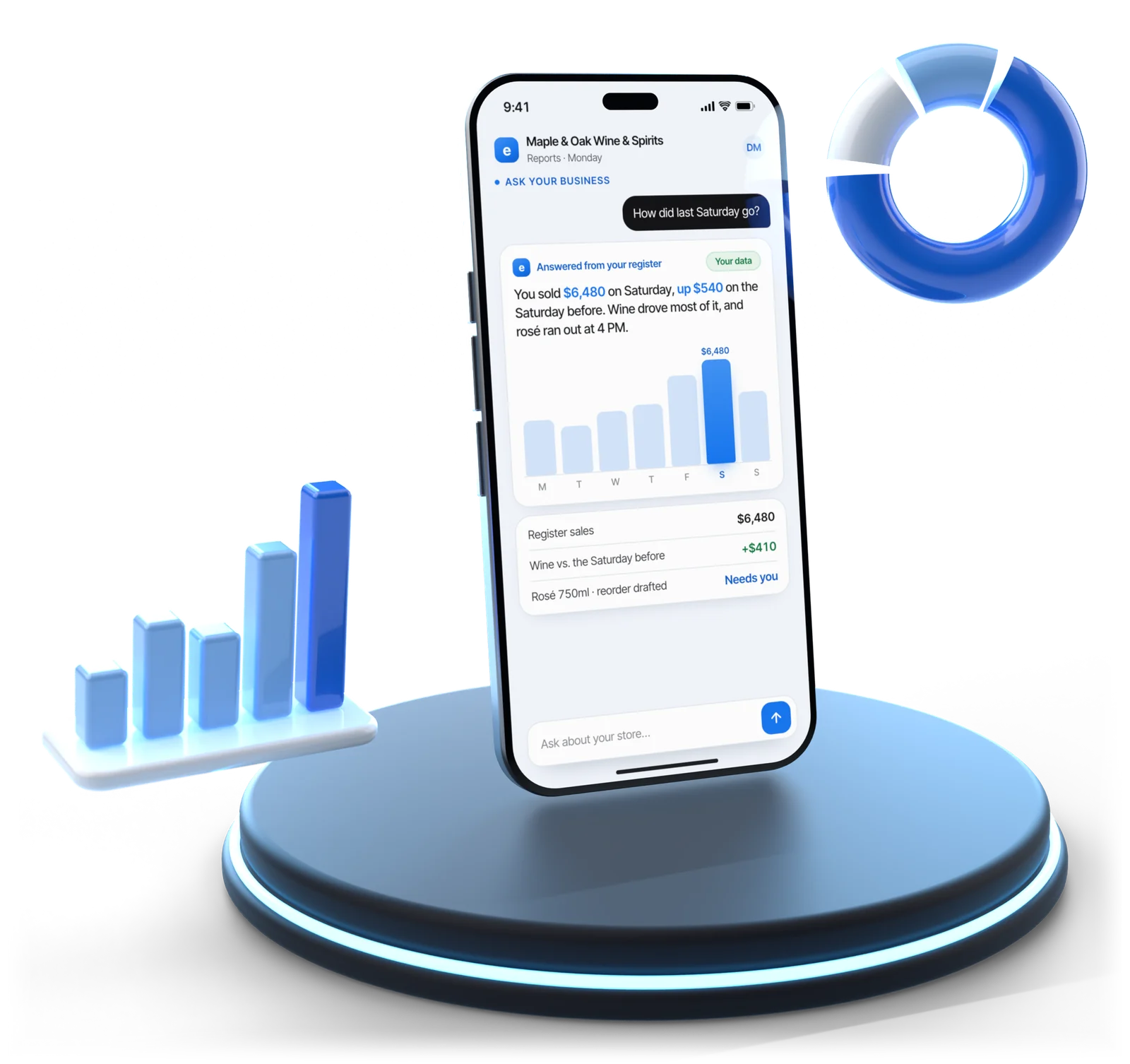
Illustrative example
In short
Esplanda's AI retail analytics answer the questions owners ask out loud (last Monday's sales, what is left of an item, how many hours somebody worked) from the business's own records, in any language it is set to.
Every answer shows its period, its location and the records behind it. It only ever sees your business, and nothing it is asked to do happens before you confirm.
- Plain-word questions
- Typed or spoken
- Your records only
- Every figure traced
- English and Spanish
What you can ask
The questions owners ask out loud
Not dashboard questions. The ones that come up standing behind the counter with a delivery due on Tuesday, which today mean four screens and a spreadsheet.
| The question | What comes back |
|---|---|
| How much did I sell last Monday? | The figure, which Monday was used, the number of sales, the average basket, the same day last year, and what your trading-day boundary did to the count |
| What is left of [two words off a shelf talker]? | Units on hand by size, weeks of cover at the current rate, any open purchase order that lands before you run out, and the cash tied up at cost |
| How many hours did Sarah work? | Which Sarah, if you can see more than one, then hours last week and so far this week, shifts, cost, and what is still scheduled |
| What were my expenses in June, and my net profit? | Revenue, cost of goods, gross margin, expenses by category, and a plain line on what the bottom figure means: it is profit, which is different from your take-home pay |
| How do I make more profit if revenue is flat? | A ranked list of specific levers in your business, each with a dollar figure, an effort rating and a risk rating, including the ones that cost money before they earn it |
| I want to grow revenue 10% this month | The target restated against a named baseline, where you are now, what the forecast says, the size of the gap, and what it means per remaining trading day |
The second row decides whether people use it. Owners know the two words on the shelf talker, a nickname, or a brand with the size guessed, rather than the exact catalog name. Esplanda answers from the words you use.
Built in, not switched on
It only ever sees your business
Which business and which locations a question may touch are decided from who is signed in, before your sentence is read. No wording anywhere in the system can name a different one.
Blocked before a single row is read
Most software keeps businesses apart by filtering: fetch, then remove what the asker should not see. Esplanda does the opposite. A question about a location outside your access stops before any data is read, so nothing crosses the boundary to be tidied up on the way back.
No hint of anyone else
A manager at one store who asks about a person's hours, where a similarly named person works at the other store, gets an answer about the one person inside their access. There is no "two matches found" message to reason backwards from.
Authority is not something a sentence can assert
Saying the owner approved it, or that you own both stores, gets the same answer the plain question got, and the attempt is recorded. A manager asking about the other store is a normal thing to do, and gets a plain answer about their own access.
Outside text is content, never instruction
Ask what a supplier's email said about the delivery. Anything inside it written as a command is ignored, the answer tells you it was there, and the attempt is escalated, because somebody trying is worth knowing about even when nothing leaked.
What Esplanda is allowed to do, and how you stop it: why Esplanda is safe to trust.
How it answers
What happens between your question and the answer
Six stages, every time. Typical lookups are built to return their first words in under a second; advice questions take longer and say what they are doing while they work.
It works out what you meant
What kind of question it is, which products, people or suppliers it names, and which period it covers. Your identity and permissions are already fixed, and nothing in the sentence can move them.
It resolves the names you actually used
Spelling, sound and the corrections you have made before. The match sits beside the answer with its confidence and what else was considered. Fix it once and it learns, for your business only.
It asks when two things genuinely match
Two people called Sarah produce a question, not a guess, and the options are only the ones your access covers.
It fetches from the one place figures live
The same definition of revenue, the same period arithmetic and the same cover calculation as every POS reporting screen, so an answer and a report always agree.
It writes over the figures, never around them
Every number in the drafted answer is checked against the records actually retrieved. A number that fails the check gets no hedge: the whole answer is held back.
It shows the working and the next step
The definition, the period in your own trading time, how complete the data was, a link to the records, and two or three follow-ups computed from what was fetched.
Periods and language
Last Monday, and why that is harder than it sounds
Two owners can ask the same six words and mean different days. A report that quietly picks one has started an argument with nobody there to settle it.
Which Monday, stated
Esplanda says which Monday it used, which removes the argument before it starts.
Your trading day, not the clock
If your day runs to two in the morning, the curbside orders rung up after midnight belong to the night they were part of. Where that changes the figure, the answer shows what counting by clock date would have given.
Every vague period, pinned down
Last September, this month so far, since we opened the second store, the last twelve weeks: each is resolved into exact bounds, and the bounds are shown.
Ask in Spanish, answered in Spanish
With United States money formatting, and product names left in English, because those are the words on the shelf talker. The figures are identical to the English answer. See multi-language business software.
Advice
Advice, with the awkward parts left in
Ask how to make more profit without selling more, and the answer is a ranked list of specific levers in your own business: each with a dollar figure, how much work it is, how risky it is, and a way to turn it into work.
Ranked by worth against effort
What a lever is worth against what it costs you to pull, so the largest number is not always at the top.
Money lost first is shown lost
Clearing dead stock books a loss the moment you mark it down. Ask about the next ninety days and that lever reads negative for the ninety days and positive over a year, and both are stated.
A gap with no known cause says so
Where counts and sales disagree by more than they should, the gap and its dollars are stated, the cause is reported as unexplained, and the answer suggests the count that would settle it.
Each figure is what a lever is estimated to be worth in your business. Act on one and the prediction and the measured result are both recorded: read how Esplanda measures results, including why the misses stay in.
You confirm
Nothing runs on a sentence alone
Talking is the least reliable input in the whole product: voices are misheard, autocorrect is confident, and a sentence typed one-handed behind a counter is not a considered instruction. So everything that sends, spends, publishes or changes a price confirms first, however permissive your own settings are.
| You say | What appears before anything happens |
|---|---|
| Message a staff member to count something | Which person, if the name is ambiguous, then the exact recipient, the exact wording, what it costs, and whether it can be undone. Nothing is created until you tap send |
| Set a revenue goal for this month | The target restated against a named baseline, where you are now, the forecast and its range, the size of the gap, and two other readings of what you might have meant. The goal exists only when you confirm one |
| Something with no matching action | A plain note saying so, and an offer to write it down as a task for a person, so nothing is reported done that was not done |
- Figures come only from your records. The prose is written over them, never the other way round.
- Your business is never compared against another customer's through this box, under any framing.
- It keeps to your business. Questions about this business get answers; everything else gets a plain note rather than improvisation.
What answers
Answers follow what you have switched on
Asking can only draw on what the rest of Esplanda knows. When a line is off for your business, the answer names the question that needs it and answers the one it can.
| Without this | Still answers | Says so instead |
|---|---|---|
| Books & Expenses | Revenue, cost of goods and gross profit | Operating profit, expenses by category and cash questions. See expense tracking software for small business |
| Forecast history | Everything about what has already happened | Run-out dates, whether a goal is reachable and what is coming, until the forecast has its first weeks of sales. See demand forecasting software |
| Employee Scheduling & Attendance | Who works for you, and name matching | Hours worked, which come from clock-in data |
| A second location | Everything about the one you have | Store comparisons appear only for people whose access covers more than one. See multi location inventory management |
Some figures cannot honestly be added across two stores, a median being the obvious one. Ask for one across a group and you get the reason, not a sum that looks right. Asking questions is part of the free Esplanda POS; the lines above are priced on their own on Esplanda pricing.
Questions
AI retail analytics questions owners ask
What can I actually ask it?
Questions about your own business, in the words you would use out loud. How much you took last Monday. What is left of an item you only know by two words on the shelf talker. How many hours somebody worked. What your expenses were in June. Why a Tuesday was bad. How to make more profit without selling more. It keeps to your business: a question about the news, an unrelated email or tax law gets a plain note that it answers about your store.
Can it see another store's data, or another owner's?
No, and not because it has been told not to. Which business and which locations a question may touch are established from who is signed in, before the sentence is read, and no wording anywhere in the system can name a different one. A question about a location you are not permitted to see stops before any data is read at all, rather than being fetched and then filtered. A manager asking about the other store gets a plain explanation of their access and an offer of the same figure for their own store.
What happens if somebody tries to trick it?
Instructions dressed up as authority do not work, because authority is not something a sentence can assert. Saying the owner approved it changes nothing. Text arriving from outside the business, such as a supplier email or a customer message, is treated as content to be read about and never as instructions to follow, and an attempt hidden inside one is reported to you in the answer and recorded. Those attempts are reviewed, because somebody trying is worth knowing about even when nothing leaked.
How do I know the number is right?
Every answer opens into its own working: the definition used and its version, the exact period in your trading time, how complete the underlying data was, and a link through to the individual records. Every figure in the answer appears in that panel. Figures come from the same place every report reads, so an answer and a report always agree.
What does it do when the data is missing?
It stops and says so. If a figure in a drafted answer cannot be traced back to a record that was actually retrieved, the whole answer is held back rather than shown with the word approximately in front of it. If the underlying data is too patchy to defend a number, it says so in plain words instead of quoting one. If a line is not switched on for your business, it names the question that needs it and answers the one it can.
Does it work in Spanish?
Yes. Ask in Spanish and the answer comes back in Spanish, in a respectful register, with money formatted the way it is in the United States. Product and brand names stay in English, because they are the words printed on your shelf talkers and translating a brand name is how somebody ends up ordering the wrong bottle. The figures are identical to the ones the same question returns in English.
Can it change things in my business if I ask it to?
Only through a confirmation you read first. A sentence never causes a change on its own. Asking it to message a staff member produces a card showing exactly who it goes to, the exact wording, what it costs and whether it can be undone, and nothing happens until you tap send. Setting a goal by talking works the same way: the target is restated, checked against the forecast, the gap is shown, and the goal only exists once you confirm it.
Is there a chat bubble following me around the app?
No. There is no mascot, no pop-up and no assistant personality. There is one place to type or speak a question, and the answer appears where you asked it. Everything else in the product works exactly as it does with the box never opened: this is depth behind a surface you already use, not a second product bolted to the side of it.
The demo takes about ten seconds
Six words, and the figure comes back with the period, the location and a link to the records underneath it. Start free today, or book a demo and we'll ask your store's questions with you.
Esplanda POS and your website are free to start, with no card needed. Add paid tools only when you want them.